Base-Editing Gene Therapy (The Ultra-Precise CRISPR)
The field of genetic medicine is entering a new era of precision engineering. While traditional CRISPR technologies revolutionized genome editing by enabling scientists to cut DNA at targeted locations, newer approaches are emerging that offer far greater accuracy and potentially lower biological risk. One of the most promising innovations is Base-Editing Gene Therapy.
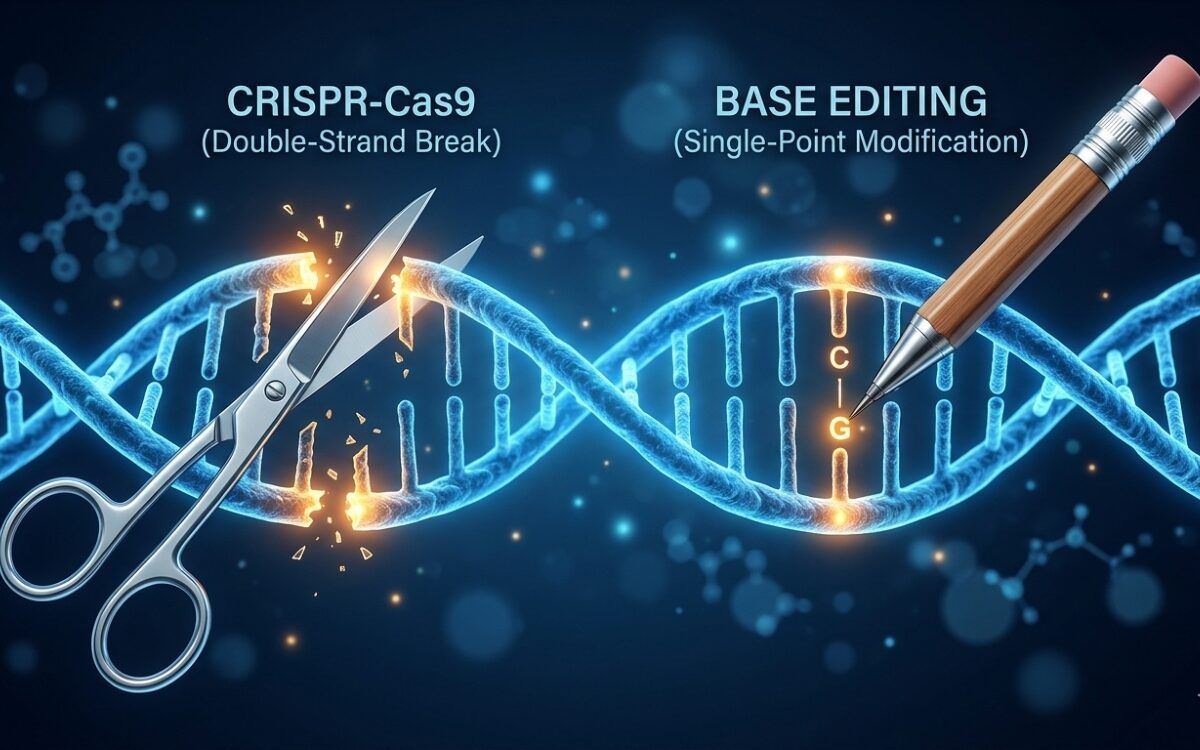
Often described as an ultra-precise evolution of CRISPR, base editing enables scientists to directly convert one DNA base into another without cutting the double-stranded DNA helix. This allows highly targeted genetic corrections at the molecular level.
Because many inherited diseases are caused by single-letter DNA mutations, base editing has the potential to correct genetic disorders with unprecedented precision.
Base-Editing Gene Therapy could become one of the most transformative breakthroughs in modern medicine, biotechnology, and precision healthcare.
What Is Base Editing?
Base editing is an advanced genome-editing technique that changes specific DNA letters—called bases—without cutting both strands of DNA.
DNA is composed of four bases:
- Adenine (A)
- Cytosine (C)
- Guanine (G)
- Thymine (T)
Base editors can chemically convert one base into another in a highly targeted manner.
Examples include:
- C → T conversion
- A → G conversion
This allows precise correction of certain disease-causing mutations.
Why Traditional CRISPR Has Limitations
Conventional CRISPR-Cas9 editing typically works by cutting DNA at specific locations.
After cutting, the cell repairs the DNA.
However, this process can introduce challenges:
- Unintended mutations
- Insertion or deletion errors
- Off-target effects
- DNA damage responses
- Chromosomal rearrangements
Base editing seeks to reduce these risks by avoiding double-strand DNA breaks.
How Base Editing Works
Base-editing systems combine multiple molecular components.
Typical workflow:
- A guide RNA identifies the target DNA sequence.
- A modified CRISPR protein binds to the location.
- A chemical editing enzyme modifies a specific base.
- The targeted DNA letter is converted.
- Cellular repair processes stabilize the edit.
The process occurs without fully cutting the DNA double helix.
Types of Base Editors
Several major categories of base editors have been developed.
- Cytosine Base Editors (CBEs)
- Adenine Base Editors (ABEs)
- Dual Base Editors
- RNA Base Editors
Each system targets specific categories of molecular changes.
Why Base Editing Is Considered "Ultra-Precise"
Base editing enables targeted single-letter modifications at extremely small biological scales.
- Reduced DNA damage
- Fewer unintended edits
- Lower chromosomal disruption risk
- More predictable outcomes
- High molecular specificity
This precision may improve safety and therapeutic reliability.
Potential Medical Applications
Many inherited diseases are linked to single-base mutations.
Potential therapeutic targets include:
- Sickle Cell Disease
- Cystic Fibrosis
- Beta-Thalassemia
- Inherited blindness disorders
- Certain liver diseases
- Rare genetic syndromes
Researchers are also investigating applications in cancer and neurological diseases.
Base editing shifts gene therapy from broad genetic modification toward molecular-level precision repair.
Base Editing vs Traditional CRISPR
| Traditional CRISPR | Base Editing |
|---|---|
| Cuts double-stranded DNA | No double-strand break required |
| Broader editing changes | Single-base precision editing |
| Higher DNA repair dependency | Direct molecular conversion |
| Greater structural disruption risk | Reduced genomic disruption |
Challenges and Risks
- Off-target editing risks
- Delivery system limitations
- Long-term safety uncertainty
- Immune response concerns
- Ethical governance issues
- Regulatory complexity
Extensive clinical validation remains essential before widespread adoption.
Role of Delivery Technologies
Efficient delivery systems are critical for successful gene therapy.
- Lipid nanoparticles
- Viral vectors
- Engineered delivery proteins
- Targeted cellular transport systems
Delivery innovation is becoming as important as the editing technology itself.
Future Outlook
The future of base-editing therapy may involve increasingly personalized and highly targeted treatments.
- Personalized genetic medicine
- One-time curative therapies
- AI-assisted genomic targeting
- In vivo precision editing
- Preventive genetic interventions
Gene editing may evolve toward highly individualized therapeutic engineering.
Ethical and Societal Considerations
As precision editing capabilities advance, ethical discussions are intensifying.
- Germline editing concerns
- Genetic equity issues
- Access and affordability
- Long-term societal impacts
- Human enhancement debates
Global governance frameworks may become increasingly important.
Economic and Strategic Implications
Base-Editing Gene Therapy could significantly reshape biotechnology and healthcare markets.
- Expansion of precision medicine industries
- Growth of genomic therapeutics
- Transformation of rare-disease treatment
- Acceleration of biotech innovation
- Creation of new therapeutic platforms
The organizations and nations that lead in precision genome engineering may shape the future of advanced medicine.
Frequently Asked Questions
What is Base Editing?
Base editing is a genome-editing technique that changes individual DNA letters with high precision without cutting both strands of DNA.
Why is Base Editing considered more precise than traditional CRISPR?
Because it directly converts specific DNA bases without creating double-strand DNA breaks, potentially reducing unintended genetic damage.
What diseases could Base Editing potentially treat?
Researchers are studying applications for genetic diseases such as sickle cell disease, cystic fibrosis, beta-thalassemia, and certain inherited disorders.
Conclusion
Base-Editing Gene Therapy represents one of the most advanced forms of precision genetic engineering developed to date. By enabling highly targeted molecular corrections without cutting DNA strands, this technology could dramatically improve the safety and effectiveness of future gene therapies. As scientific understanding, delivery systems, and clinical validation continue advancing, base editing may become a cornerstone of next-generation precision medicine and genomic healthcare.