Microgravity Bio-Manufacturing
The convergence of biotechnology, space infrastructure, advanced materials science, and commercial space stations is creating a new industrial frontier known as Microgravity Bio-Manufacturing. For decades, scientific experiments conducted aboard space stations demonstrated that biological processes behave differently in microgravity environments. Today, researchers and private companies are exploring how these unique conditions can be used to manufacture high-value biological products that are difficult—or impossible—to produce on Earth.
As commercial space stations, orbital laboratories, and reusable launch systems become more accessible, microgravity is increasingly being viewed not just as a research environment but as a manufacturing platform. This shift could transform pharmaceuticals, regenerative medicine, tissue engineering, biomaterials, and next-generation healthcare technologies.
Microgravity Bio-Manufacturing may become one of the most valuable sectors of the emerging space economy.

What Is Microgravity Bio-Manufacturing?
Microgravity Bio-Manufacturing refers to the production of biological materials, pharmaceuticals, tissues, and advanced biomedical products in low-gravity environments such as orbital laboratories and commercial space stations.
These environments offer unique physical conditions that influence biological processes.
Potential products include:
- Advanced pharmaceuticals
- Protein crystals
- Artificial tissues
- Stem-cell therapies
- Regenerative medicine products
- Biomaterials
- Organoid cultures
Microgravity creates manufacturing opportunities unavailable under Earth's gravity.
Why Microgravity Matters
Gravity influences fluid dynamics, sedimentation, cell growth, and molecular assembly.
In microgravity:
- Convection is reduced
- Particles remain suspended longer
- Cells grow differently
- Crystal formation improves
- Biological structures self-assemble more efficiently
These effects can improve the quality and performance of certain biological products.
How Microgravity Bio-Manufacturing Works
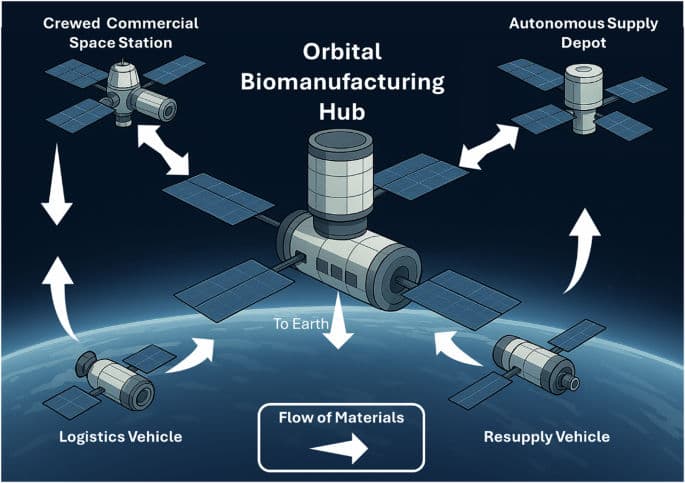
Production occurs within specialized orbital laboratories equipped with biotechnology systems.
Typical workflow:
- Biological materials are launched into orbit.
- Experiments are initiated in microgravity facilities.
- Cells, proteins, or biomaterials are cultured.
- Growth and production processes are monitored.
- Finished products are prepared for return.
- Materials are transported back to Earth.
Orbital facilities effectively become biological manufacturing plants in space.
Key Technologies Enabling Microgravity Bio-Manufacturing
- Commercial Space Stations
- Bioreactor Systems
- Automated Laboratory Platforms
- Robotic Manufacturing Systems
- Advanced Life Sciences Equipment
- Reusable Launch Vehicles
- Remote Monitoring Technologies
These technologies enable continuous production and experimentation beyond Earth.
Protein Crystal Manufacturing
One of the earliest and most promising applications involves protein crystallization.
In microgravity:
- Crystals often grow larger
- Structural defects may decrease
- Molecular organization improves
- Drug development research benefits
Higher-quality protein crystals can support pharmaceutical discovery and molecular analysis.
Tissue Engineering and Regenerative Medicine
Microgravity may help create more complex biological structures.
- 3D tissue growth
- Organoid development
- Stem-cell research
- Regenerative therapies
- Bioprinting applications
Researchers are investigating how space-based manufacturing can support future healthcare innovations.
Microgravity transforms space from a research destination into a biological manufacturing environment.
Applications Across Industries
- Pharmaceutical Development
- Regenerative Medicine
- Biomedical Research
- Advanced Materials Engineering
- Biotechnology Manufacturing
- Precision Healthcare
- Space Medicine
Microgravity manufacturing could create entirely new product categories.
Traditional Bio-Manufacturing vs Microgravity Bio-Manufacturing
| Traditional Manufacturing | Microgravity Manufacturing |
|---|---|
| Earth gravity constraints | Microgravity environment |
| Convection-driven processes | Reduced convection effects |
| Limited structural formation | Enhanced biological assembly |
| Ground-based production | Orbital production facilities |
Challenges and Risks
- Launch and transportation costs
- Limited orbital manufacturing capacity
- Product return logistics
- Regulatory approvals
- Biological contamination risks
- Space infrastructure dependence
Commercial viability depends on reducing operational costs and increasing production scale.
Future Outlook
The next decade could witness the emergence of dedicated orbital biotechnology ecosystems.
- Commercial microgravity laboratories
- Autonomous orbital bioreactors
- Space pharmaceutical factories
- Regenerative medicine production hubs
- AI-assisted biological manufacturing
Microgravity may become a valuable industrial resource rather than merely a scientific curiosity.
Economic and Strategic Implications
Microgravity Bio-Manufacturing could become a major pillar of the future space economy.
- Expansion of commercial space markets
- Creation of high-value biomedical products
- Acceleration of pharmaceutical innovation
- Growth of orbital manufacturing industries
- Strengthening of biotechnology competitiveness
The organizations that successfully commercialize microgravity manufacturing may establish leadership in an entirely new industrial sector.
Frequently Asked Questions
What is Microgravity Bio-Manufacturing?
It is the production of biological materials, pharmaceuticals, tissues, and biomedical products in low-gravity space environments.
Why manufacture biological products in space?
Microgravity can improve crystal growth, cellular organization, and biological assembly processes that are difficult to achieve on Earth.
Which industries could benefit most?
Pharmaceuticals, regenerative medicine, biotechnology, biomedical research, and advanced healthcare industries.
Conclusion
Microgravity Bio-Manufacturing represents a groundbreaking shift in how biological products may be developed and produced in the future. By leveraging the unique conditions of space, researchers and companies can explore manufacturing pathways unavailable on Earth. As commercial space infrastructure expands and costs continue to decline, microgravity could become a strategic production environment for next-generation pharmaceuticals, regenerative medicine, and advanced biotechnology innovations.